
Hands
and fish.


Photos, clockwise from top left -
My hands, showing off my beady bangles, second podding some delicious broad beans.
“Mickey’s hands whilst stripping thyme for me for a dish when cooking in Ibiza. I liked the roughness of his tattooed hands whilst delicately stripping fresh thyme. He was an ex magician.” - From a new series of chefs cooks and friends - @selinasnowpaintings
Note - Selina’s paintings - they are gorgeous and vital and make you want to be at the table with this food and these people.
Dimpled knuckles of a small child’s hands mixing coleslaw in a workshop with Ein Cegin.
Grandma’s Hands. My mother’s hands - she was grandmother to so many I have lost count, and while she wasn’t really the sort of grandma this song and beautiful animation is about, similarities are there as both mother and grandmother. These are her hands stripping homegrown black currants to make jam. I still have a jar from 2023. I can’t bear to open it as there will never be another one.
Hands are like faces, they have character and show the voyage of the human attached in dimples, scars, veins, liver spots, wonky knuckles, neat manicures and missing digits.
My brother Barny once said that a cook’s best tools are their hands. In fact he has said it many times, he’s a chef and a food educator and so has had many students to say it to over the years. I suppose you could argue that they are an artist’s or mechanic’s best tools as well, and that would also be true. They are a human being’s tools, with our opposable thumbs giving us precise pincer movements and ability to use the index finger to point at things we want, we are streets, maybe, ahead of our nearest ape relatives.
A mechanic has permanently oil stained nails (or they used to until cars became computers to be fixed with an ipad), a carpenter will have roughened hands with probably at least one bashed in finger. Writers used to have writer’s bumps on the top knuckle of their middle finger (right or left depending on how they were designed), but now they have sore finger tips from bashing the qwerty key board. Painter’s hands, both of the artistic and more practical kind, are always paint splattered.
My hands are getting quite gnarly these days, with arthritis, fat old veins and age spots, finger nails invariably grubby with soil or whatever food I’ve been peeling or chopping (I do wash them in between, rest assured). My mum’s hands became gnarly too as she aged, swollen knuckles and wrists. She had a very distinctive thumb nail on her left hand because it had been shut in a car door decades ago, I remember it from when I was very small, when it had already healed but into a strange new shape.
Children’s chubby hands have delicious little dimpled knuckles. My little sister’s hands were like that I noticed when I held them, pulling her up as she clambered up the end of the bunk to my bed from hers, soggy nappy swinging .
So anyway, I have been musing on hands because I get transfixed by them when I see them working. They are so capable and strong, even when they are losing both those attributes little by little. My hands have done a fine job so far, and while they are not serving me quite so well these days I will still decorate them with rings and pretty nail colours, even while I continue to sink them into the soil or the guts of a chicken.
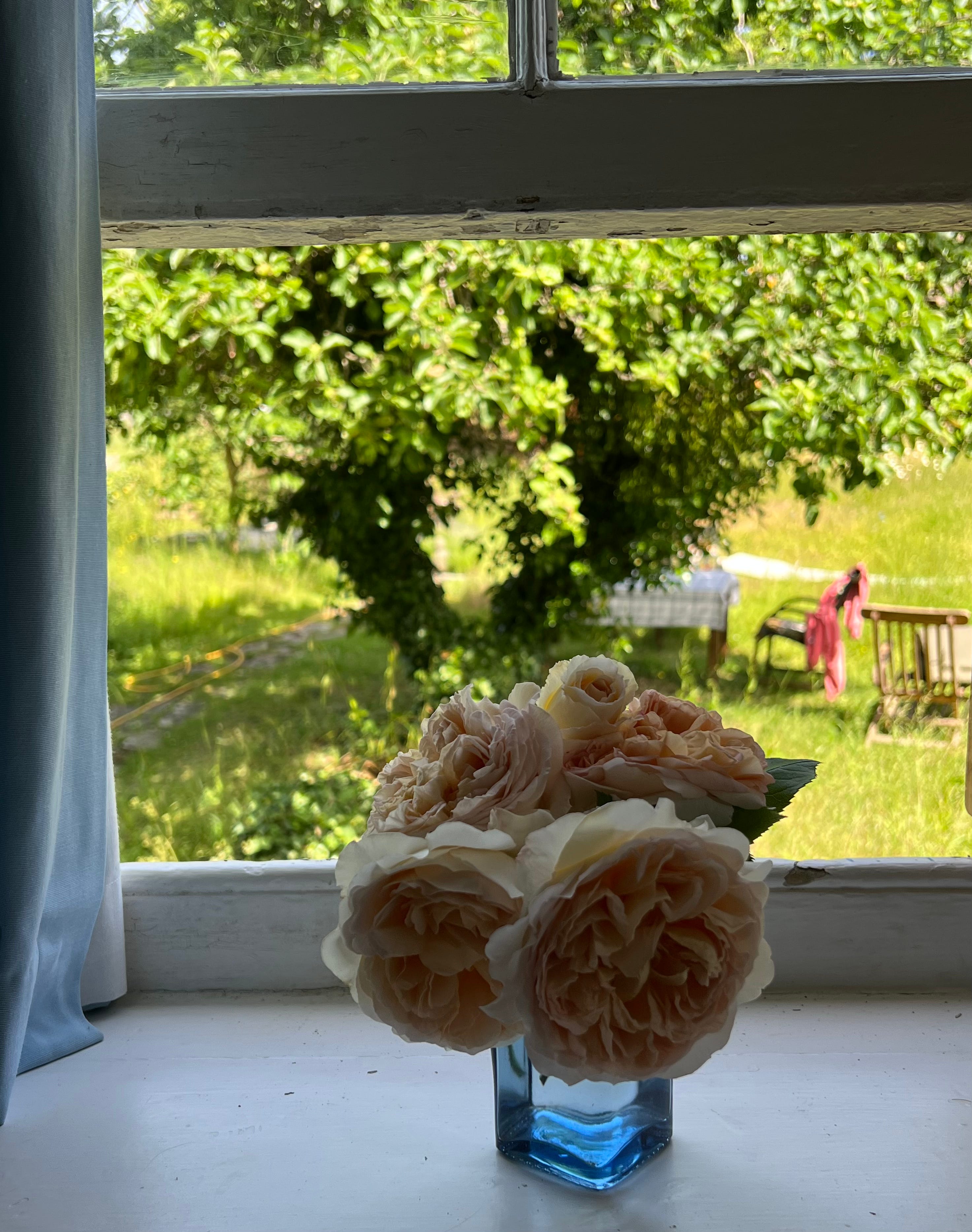
I spent this last weekend with my sisters. A weekend with my sisters always fills my cup with love, total I-get-you-ing, wine, chat, support, inspiration and endless food. We do this periodically and it’s always a time out of time, a reminder of our luck in having each other and a place to be together. We were never the kind of sisters who shared make up (voluntarily anyway) as the gaps in our ages didn’t make us exactly contemporaries, but as we have become older we seem to have become closer in age, and those gaps that took us in very different directions through our lives are now lessening.
I will talk more about these fabulous woman another day but for now I want to talk about the food - there is always so much of it when we get together. My idea of a snack is a packet of crisps, theirs is a tossed salad, a cheese selection, crackers, chutneys and a glass of wine. We decided to call it lunch, because that’s what it really was.
It was dinner that was the spectacle - salt baked sea bass buried in a sarcophagus of salt, bound with egg white. Neither my sisters nor I can take credit for the recipe but it was Emma who found it, so kudos to her. It is here on substack, by Nicola Fairbrother in her stack called Olympian Kitchen. She doesn’t seem to have posted since 2024 so I am copying and pasting the recipe rather than just linking, just incase she disappears from this platform (I couldn’t paste the video so watch it there if you’re interested). I will make this again - I have never had such delicious sea bass (except once in a restaurant on the border of France and Switzerland but that’s another story for another day). Fish of this quality is a rare treat and its worth seeking out and treating very simply and with appropriate quantities of awe. And yes, we did raise a glass to the beautiful creature.
Bass was from Torbay Fish - a family company from Brixham who sell in Bruton on Fridays. Despite living by the sea and there being fishing villages all over the place there are very few fresh fishmongers in my area, although we are lucky to have Cardigan Bay Fish locally for crab and lobster. I have recently discovered Pesky Fish - an online fish market which delivers, I haven’t used them but will do at some point. Sustainability is always an issue with seafood, and it’s often hard to know where to turn to be sure - but check your sources as far as you can.
Salt-Baked Whole Sea Bass
by Nicola Fairbrother
Crack it open at the table. Peel back the skin and reveal the moist white flesh underneath. The salt-crust acts like a mini-oven, trapping in all the steam and juices of the fish. If you’ve only ever roasted fish before you are in for a real treat. Very juicy and moist. And no, not salty. (especially if you don’t knock the salt crystals in to the fish as you peel back the skin)
Pescado a la sal. You can use this method for many types of fish; trout, turbot, corvina, bream. Here, I’ve used whole sea bass, and you can get an idea of how easy it is to do in this 28 second video.
And I assure you - that’s it. It really is that easy to salt-bake a whole fish.
Use coarse salt. Table salt is too fine and will be absorbed by the fish making it salty. Maldon will bankrupt you. Just use ordinary coarse salt. Out here, in Spain, it costs around 1 euro for a 2kg packet.
The salt, when mixed with egg white and heated creates a crust, encasing the fish, stopping any juices evaporate. It keeps the fish steaming in it’s own juices.
How long to cook the fish for?
Depends on weight. Work on: 20 mins per 1kg of fish at 180°C / 355°F.
You can use a thermometer to make sure the internal temperature of the fish has reached a safe 63°C / 146°F. But be aware of carry on. Take the fish out a few degrees earlier as it will continue to cook in the salt crust as you mess around cracking it open.
But don’t sweat it too much. Salt-baked fish in Spain, dates back to the pescaderos who would cook the doradas they’d caught, encased in salt scraped up from the salt flats. I’m sure the fishermen neither had timers or thermometers. Nor recipes for that matter.
Salt-Baked Whole Sea Bass
1 whole sea bass (you can use whole turbot, trout, corvina)
1 kg coarse sea salt
100 g egg white
Step 1: Fish
Get the fishmonger to gut the fish.
Note the weight of the fish (this is important to know for cooking times.)
Rinse the fish under cold running water and pat dry.
Lightly oil the surface of the fish (this helps the salt slip off later.)
Step 2: Salt
Mix the egg white with the coarse sea salt until the mixture feels like wet sand.
Line a tray with baking paper (makes clean-up easier, you’ll thank yourself later).
Place a little of the salt on the baking tray and place the fish on top of the salt.
Cover the fish with the rest of the salt mixture. Pack it in tightly.
Step 3: Oven
Place the dish in a preheated oven at 180°C / 355°F for fifteen to twenty minutes per kilogram of fish.
You can use a thermometer to check the internal temperature of the fish which should reach 63°C / 146°F.
How to serve it?
With aioli, braised leeks and dill
With herb mayonnaise and buttery, minty new potatoes
With hollandaise and steamed asparagus
We served it with absolutely plain, brand spanking new potatoes, a green salad with slivers of fresh fennel and the most glorious hollandaise ever (made by Sue). The fennel fronds in the picture were pointless but looked pretty - they added nothing to the flavour, although we thought of it they might have if we had stuffed them inside.


Beautiful, clear eyed fish
Wrapped in eggy salt (we tipped off excess water)
Baked
Glass of something while the fish rested
Thwacking it with the back of a spoon
The fish emerges from its sarcophagus
Expert (ish) carving up of the fish (and talking of pretty nail colours look at these beauties!)
Silky Hollandaise, matching the nails and the candle light
The sunset before our return to normal life
No push or pull or vying for head chef - pure intuitive collaboration, seamless, if a little forgetful at times.
I have decided that I have to make this substack more than just wafflings, so while this may not be the very last of it’s kind, my hope is to create a real focus to my writing, make it more regular and hopefully more interesting and even sometimes useful, always of course with food at its core. I have a few hugely kind and generous patrons out there who I would like to prove worthy of, and the rest of you too natch. I have some ideas but if anyone has any thoughts on this I am agog to hear them. Agog is such a ridiculous and excellent word. Until next time muchachos.
Sorry to have missed the fish. I had pizza from Bara Menyn. Good but not the same. And you have lovely hands that don't shake, unlike mine.
Lovely post and prose, as always. Sounds like a wonderful time, and the fish looks excellent. I for one see no reason for you to change your focus or way of substacking (if that's a word) -- your posts are *always* worth reading, and a joy, though given my memory, I often forget to check for new ones!
The fish reminds me of a roast recipe my father found when I was a kid and cooked. (He cooked it, I mean, not that I was cooked as a kid.) The roast was smothered in a mustard and salt mixture, much like the egg and salt mixture for the fish, then placed directly in the coals of a charcoal grill, with coals piled up around it. I looked ghastly when done -- black -- but tasted heavenly by some alchemy of fire, salt, and mustard.